
Elektroentionisierung (EDI)

Electrodeionization (EDI) is an electrically driven water treatment technology that combines direct current, ion exchange resins, and ion-selective membranes to remove ionic impurities from the water. The impurities are discharged via a concentrate stream, leaving behind purified product water.
By removing impurities and continuously regenerating the resins, they do not become exhausted, thus maximizing their lifespan. A single EDI module can be used for many years before replacement is necessary. The process reliably produces product water with a resistance of >15 MΩ cm. This technology is therefore a viable alternative to disposable reprocessing cartridges.
The development and use of EDI technology overcame some of the limitations of ion exchangers, particularly the release of ions when the resins are exhausted.
How does EDI work?
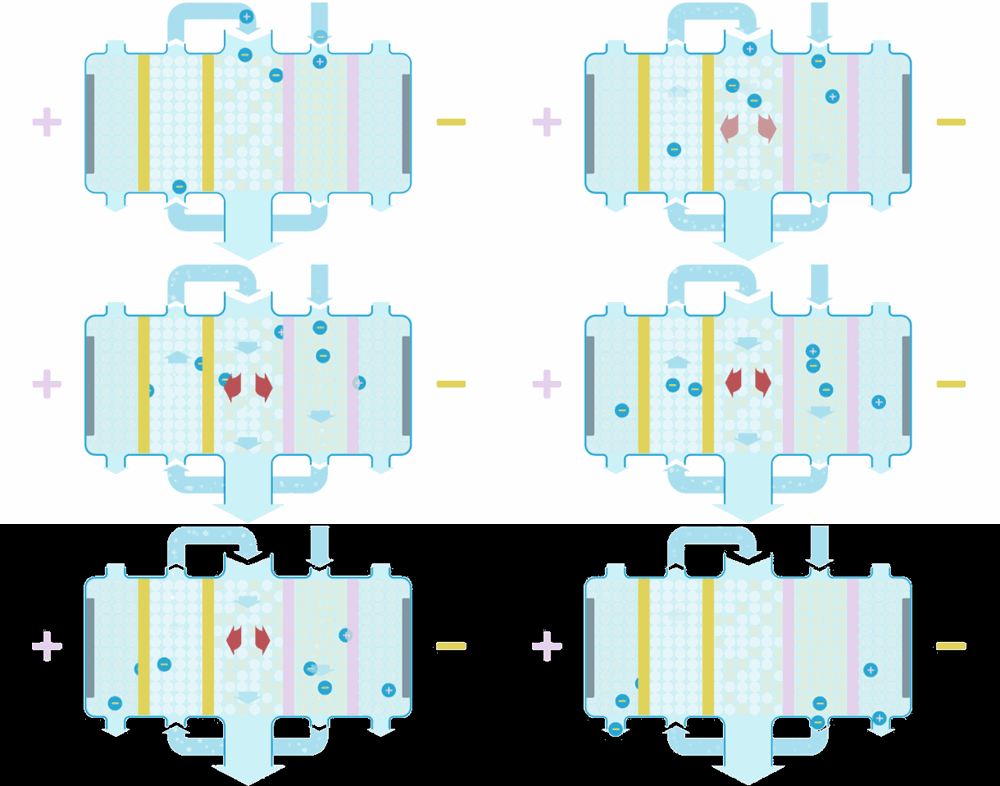 Water enters the EDI module, where an applied current forces ions to move through the resins and across the membranes. These ions are collected in concentrate streams, which can then be drained or recycled. The deionized product water can then be used directly or subjected to further treatment to increase its purity.
When ions are moved through the resins and between the cation- or anion-selective membranes, they are exchanged for H + and OH- ions . Ions bound to the ion-exchange resins migrate into a separate chamber under the influence of an externally applied electric field. This process also generates the H + and OH- ions necessary to maintain the resins in their regenerated state. Ions in the separate chamber are then flushed away.
The ion exchange resins in our EDI systems are continuously regenerated, so they do not become exhausted like ion exchange layers in batch operation.

